


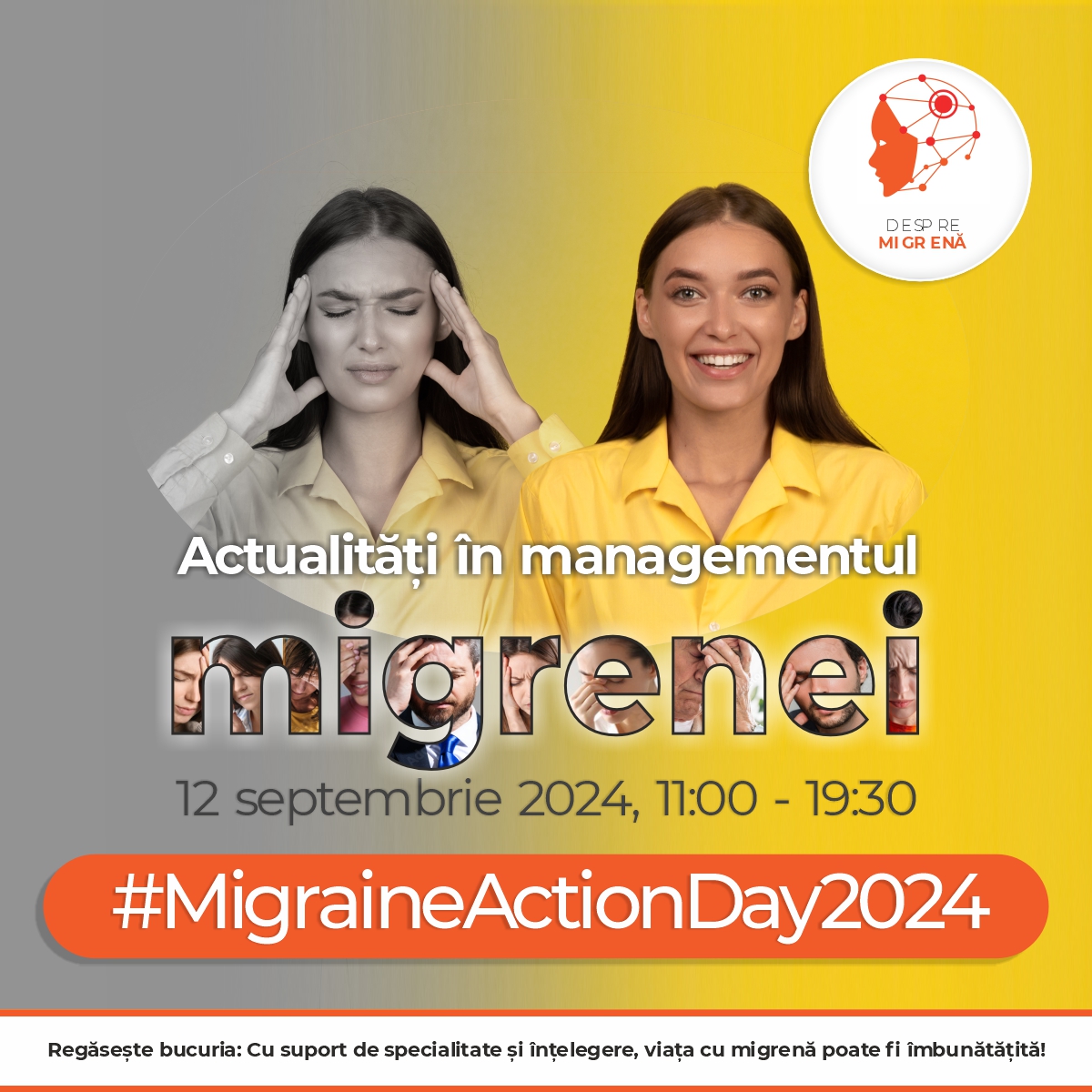
International Migraine Awareness Day is celebrated annually across Europe on September 12th! It is an opportunity to raise awareness of this complex neurological condition that affects 12-15% of the population. Migraine is under-recognized, under-diagnosed, and under-treated, but we are currently in an exciting period when new information and therapies are emerging internationally, which are profoundly changing its management. It is important for patients, caregivers, and the general public to be aware of these developments, as with proper support and understanding, life with migraine can be improved!
Asociația CREDU, in partnership with Headache Society Romania, is running an extensive awareness campaign that covers aspects related to diagnosis, treatment, and migraine management. On September 12th, a full-day marathon event will be held in-person at the Capital Plaza Hotel in Bucharest, featuring 15 specialists, including expert neurologists in migraine, psychologists, physiotherapists, and expert patients, who will address both theoretical and practical aspects of the condition.
“Migraine is one of the most common primary headache syndromes, a condition encoded genetically in us, a part of our lives since the dawn of humanity. Today, after perhaps hundreds of thousands of years of suffering without answers, we now have a vast therapeutic arsenal to control the disease. In this new era, it is perhaps the first time in history when migraine can, and should, be completely controlled. It is a moment of major change, a reform, when treatment guidelines are changing, when healthcare systems need to adapt to the new wave of therapies, when doctors must change their approach, and when patients need to become active participants in controlling symptoms. This is a time full of optimism and enthusiasm, and we are responsible for being an active part of it,” says Dr. Vlad Tiu, a neurologist at Elias University Emergency Hospital and former member of the Headache Scientific Committee of the European Academy of Neurology (EAN).
New this year from Asociația CREDU is a free online questionnaire through which anyone suffering from headaches can find out if what they are experiencing could be diagnosed as a migraine. The questionnaire is available on the website despremigrena.ro and on social media platforms.
Additionally, a video animation draws attention to the triggering factors and aspects that can be avoided by patients. Diet, irregular meals, stress, sleep patterns, intercurrent infections, certain oral contraceptives, hormonal imbalances, certain types of exercise, and weather changes influence the daily lives of people with migraine, requiring intervention strategies for better management. These should complement acute and preventive treatment, not exclude it.
“In migraine, the headache is just the tip of the iceberg. Migraine is not just a simple headache; it is a complex neurological condition that involves changes in brain functionality and can be associated with other pathologies. Migraine is one of the leading causes of disability among young adults,” says Dr. Bogdan Pană, a neurologist specializing in migraine at the Emerald Medical Center.
“Migraine affects millions of people worldwide, with a profound impact on quality of life. Migraine is not just a severe headache, but a debilitating disease accompanied by various other symptoms that can last from hours to days. Current therapeutic options and migraine management strategies, however, offer real solutions for patients. It is essential for those suffering from migraines to consult a specialist to receive an accurate diagnosis and personalized treatment, which can transform a life of suffering into a normal life. For many affected individuals, migraine significantly interferes with daily activities, intellectual work, and social relationships,” adds Dr. Elena Terecoasă, a neurologist specializing in migraine at the Bucharest Emergency University Hospital.
Migraine has a profound impact on quality of life, both personally and socially, interfering with education, social activities, and career. Migraine is important to society and employers because it mainly affects adults in their productive years. It is proven to be the second most common cause of short-term absenteeism in employees, not counting presenteeism (inefficiency at work during migraine attacks). Globally, it is the second leading cause of years lived with disability, and the leading cause of disability in young women.
The main issues related to stigma arise particularly from its misunderstanding by the public, and this is the aspect covered this year by the #EuSunt #IamAPersonWithMigraine campaign, run on social media through a contest.
“I am strong. I am capable. I am efficient. I am willing. I am a fighter. I am resilient. I am so normal. I am a person with migraine and I am proud of myself. We are proud of ourselves. Stigma is only in the minds of others, until we can free ourselves from it,” says Cristina Vlădău, migraine patient and migraine project manager at Asociația CREDU.
By raising awareness about the impact of migraine, the lives of people with migraine and their caregivers can be improved! On this action day for migraine, #MigraineActionDay, you are invited to join the global effort to raise awareness about the challenges faced by people with this widespread neurological condition, including in Romania!
The #DespreMigrenă campaign is supported by Lilly/Organon, Pfizer, and TEVA.
#MigraineAwarenessDay2024
________________________________________
Migraine Facts
Migraine is a complex neurological condition, identified worldwide as the leading cause of years lived with disability in people under 50 years old, the leading cause of disability in young women, and the second leading cause of disability globally. It is estimated that 2.3 million adult Romanians suffer from migraines of varying severity (1 in 7 people). Migraine often begins at puberty and primarily affects adults in their productive years but can also occur in children and the elderly. Migraine does not discriminate; it is found in people from all social backgrounds and professions.
Abroad, 90% of patients are managed with the help of a family doctor, 9% with the help of an outpatient neurologist, and only 1% have severe forms that require intervention from a migraine specialist. In Romania, there are no statistical data regarding migraine diagnosis. The vast majority of migraine patients do not consult a doctor, whether a family doctor or neurologist, but self-diagnose and unfortunately self-medicate. Many patients who go to a pharmacy for headaches do not have a clear diagnosis or a recommendation from a specialist, relying on information from television, friends, or neighbors.
Fortunately, research in brain health has advanced rapidly in recent years. There are now clear diagnostic criteria for this neurological condition, and new targeted treatment classes have emerged. There is no universal cure for migraine, but the severity of attacks can be reduced, and steps can be taken to prevent headaches. In Romania, we already have access to new therapies, gepants, and monoclonal antibodies. Access to these new therapies is challenging, but it offers hope for patients, and awareness campaigns need to provide information to the general public to demand proper evaluation and management of migraine.
Acute treatment involves non-specific medications (nonsteroidal anti-inflammatory drugs and antiemetics) or migraine-specific medications—designed for this condition and prescribed by a doctor, such as triptans or newer treatments like ditans and gepants.
Preventive treatment, recommended for patients with severe, frequent, and disabling attacks, aims to reduce the frequency, severity of episodes, and improve quality of life. Traditional pharmacological therapies include beta-blockers, some anticonvulsants (topiramate, depakine), and candesartan, while newly developed therapies specifically designed for migraine prevention include monoclonal antibodies targeting CGRP. Non-pharmacological therapies are also recommended, including neuromodulation devices or cognitive-behavioral therapies.
About Asociația CREDU
Asociația CREDU – Creative Education was founded with the aim of promoting the concept of creative education in health. In recent years, it has been dedicated to organizing a series of online and offline projects for adults and children, aimed at informing and raising awareness on important health-related topics.
www.despremigrena.ro www.credu.ro
About Headache Society Romania
The “Headache Society” Association, a member of EMHA (European Migraine and Headache Alliance), is a non-governmental, non-profit association of patients with headaches and medical professionals, with the goal of increasing medical education on headache and facial pain disorders, aiming to facilitate patient access to modern treatments.
www.headache.ro